

For industrial processes, renewable energy, power plants or heating, ventilation and air conditioning systems, FUNKE offers thermodynamically optimized solutions with plate heat exchangers that can be applied practically anywhere.
"Funke" heat exchangers and their parts

Whether it is shell heat exchangers, plate heat exchangers, air-cooled heat exchangers or electric oil heaters, FUNKE offers thermodynamic solutions for practical application in all industrial sectors. In addition to heat exchangers of modular construction, we also manufacture according to customer specifications based on international standards and regulations.


Gasketed plate heat exchangers
Gasketed plate heat exchangers consist of thin corrugated plates, which are sealed using rubber gaskets and pressed into the frame with screws. It can be removed for cleaning and maintenance. In addition, more wafers can be added later to achieve higher productivity.
In order to cover the widest possible power range, several sizes are available with different number of plates and different designs. Heat exchangers can work with highly contaminated or highly viscous fluids, as well as when the temperature difference between hot and cold media is minimal. Depending on the application, special plates made of higher quality materials such as titanium plates for seawater applications are available.
Advantages of gasketed plate heat exchangers
- High thermal capacity due to OptiFlow, Bypass Stop and Best Wave systems.
- Lower investment costs due to compact design.
- Convenient service and maintenance thanks to high efficiency self-cleaning due to turbulent flow, visual identification of gaskets and the use of clip-on gaskets.
FP SERIES
Gasketed plate heat exchangers
Technical data
- Nominal connection values: DN 25 - DN 500 for volume flows of 0.5 m³/h - 4,500 m³/h
- Heat exchange surface/plate: 0.04–3 m²
- Max. number of plates: 125–800
- Max. operating pressure: 25 bar
- Max. operating temperature: 200°C
Safety
Double sealing in the inlet and outlet areas to prevent media mixing.
FPDW SERIES
Gasketed safety plate heat exchangers
Technical data
- Nominal connection values: DN 25 - DN 200 for volume flows of 0.5 m³/h - 700 m³/h
- Heat exchange surface/plate: 0.04–1 m²
- Max. number of plates: 150–700
- Max. operating pressure: 25 bar
- Max. operating temperature: 200°C
Safety
Designed with double plates with a special sealing system.

Brazed plate heat exchangers
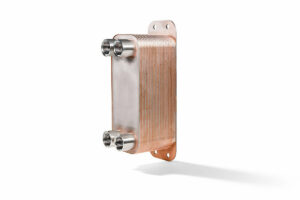
Brazed plate heat exchangers are made from stamped stainless steel plates which are vacuum brazed to form a pressure resistant block of copper or nickel depending on the applicable requirements. Such heat exchangers can be used at high pressure and high temperature, but their design remains compact.
Advantages of brazed plate heat exchangers
- High thermal capacity: diagonal media routing and turbulators in the flow gaps.
- Highly resilient thanks to seam brazing rather than spot brazing
- Compact design also suitable for high-viscosity media because of high heat transfer
- Direct connection to the power unit without any additional holders thanks to elongated end plate
 TPL SERIES
Areas of application
Primarily in the fields of hydraulics, compressed air, engine cooling and heat recovery. Universal use with various media. Extremely high heat transfer capacity due to the diagonal direction of the medium and special turbulator devices in the flow gaps. For higher viscosity material, the high heat transfer allows for the use of smaller units, which in turn take up less space.
Technical data
Heat exchange surface/plate: 0.035–0.286 m²
Max. operating pressure: 36 bar
Max. operating temperatures: +200°C
 GPL / GPLK / NPL / NPLK series
Areas of application
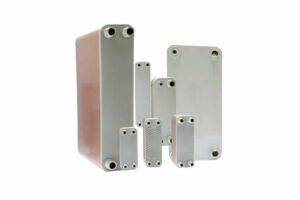
Mainly used for heating, air conditioning, ventilation, engine cooling and recuperation. Universal use with various media.
Technical data
- Max. operating pressure: 16–30 bar
- Max. operating temperatures: +200°C
- GPL / GPLK: plates brazed with copper
- NPL / NPLK: plates brazed with nickel
Available as a safety heat exchanger with double walls.

In the segment of shell-and-tube heat exchangers, FUNKE has a proven range of serial models as well as customized individual solutions. The product range also includes safety heat exchangers, providing solutions for all thermodynamic mechanical and systems engineering requirements. Shell-and-tube heat exchangers are mainly used to cool or heat fluids such as grease, hydraulic oil or water based on saturated steam. Water, water/glycol mixtures or seawater can be used as the cooling medium.

BCF, CCF, SSCF
- Tube bundle fixed or removable
- Exchange areas from 0.11 m² to 11.45 m²
- Internal pipe dimensions: 6.35 x 0.5 mm and 9.5 x 0.8 mm
- Variable baffle spacing
- Tube side 1-, 2- or 4-way
- Horizontal or upright design with angled or clamping feet or stand
- Design pressure, shell side: 16 bar
- Design pressure, tube side: 10 bar
- Design temperature BCF / CCF: -10 / 150 °C, - SSCF: -10 / 230 °C
- Type examination in acc. with PED 2014/68/EU Module B
- CE marking

TDW
- Removable U-tube bundle with finned tubes
- Spiral deflection principle for high specific heat transfer performance
- Exchange areas from 0.05 m² to 1.5 m²
- Internal tube dimensions: 14 x 1 mm in acc. with DIN EN 12452
- Pipe side 4-way
- Also available as tank installation variant TDW T
- Design pressure, shell side: 16 bar
- Design pressure, tube side: 8 bar
- Design temperature: 100°C
- Type examination in acc. with PED 2014/68/EU Module B
- CE marking

UNIVEX
- Removable tube bundle
- Exchange areas from 0.15 m² to 5.79 m²
- Internal tube dimensions: 6 x 0.5 mm
- Pipe side 4-way
- Design pressure, shell side: 16 bar
- Design pressure, tube side: 10 bar
- Design temperature: -10 / 120°C
- Without type examination and without CE-marking
Individual solutions
In addition to series models, FUNKE supplies individual solutions in the shell-and-tube heat exchanger segment. Project engineering creates an optimal thermodynamic solution based on operational data, building regulations and specifications. A technically and economically optimized solution is always found that fully meets both the customer's needs and the company's standards to ensure maximum system security and efficiency.
We manufacture custom-made shell-and-tube heat exchangers with a diameter of up to 3000 mm and a maximum weight of up to 60 t. External and internal coatings can also be applied, such as seawater and acid resistant coatings inside pipes and pipe assemblies.

CP (TEMA TYPE W)
Design features
- Robust design, removable smooth tube or finned tube bundle facilitates inspection
- Safety sealing of the floating tube sheet thanks to two seals and intermediate ring with signal holes
Application
Universal use – for liquid heat transfer and gas cooling. Typical application: oil cooling in hydraulics, large engines. Can be used as intercooler and aftercooler for compressors etc.

A-100 (TEMA TYPE W)
Design features
- 1-way, removable smooth tube bundle with floating base
- Broad size graduation thanks to large number of standardized units
Application
Cooling and drying of process gas or compressed air. Used as an intercooler or aftercooler in the compressor industry. The gas passing through the pipes is perfect as a pipeline coolant in the pipeline network.
C-100 (TEMA TYPE P)
Design features
- The removable tube bundle with ring seal enables greater length differences resulting from different heat expansion between shell and inner tubes
- The tube bundle can be removed without loosening the end cap of the floating base
Application
Heat exchanger suitable for heat treatment of various media, air or gas. Can be used as an intercooler or aftercooler.

C-200 (TEMA TYPE M)
Design features
- Non-removable tube bundle with or without compensator in the shell
- Very good heat transfer performance thanks to maximum exchange area in the shell
Application
Intended for cooling and heating of various media and various mechanical and system engineering processes.

C-300 (TEMA TYPE U)
Design features
- The removable U-tube bundle with ring seal enables greater length differences resulting from different heat expansion between shell and inner tubes
Application
Especially suitable for cooling and heating various media at higher pressures. Can be used as a steam generator and condenser, also in processes with large temperature differences.

C-400 (TEMA TYPE T)
Design features
- Removable tube bundle with a deflection chamber fastened to the floating tube sheet
- Tube bundle can be removed without loosening the deflection chamber
- This version has a large bundle inlet zone
Application
Process cooler, intercooler or additional cooler for gas and air, steam condenser. The field of application is mainly in the chemical industry.

C-500 (TEMA TYPE S)
Design features
- Removable tube bundle with deflection chamber fastened on the inside with clamping ring design
- Designed for strong heat expansion differences between shell and inner tubes
- Largest exchange area with shell diameter equivalent to other types
Application
Meets the highest demands (e.g. large temperature fluctuations) in the chemical industry and oil refineries. In addition to thermal treatment of liquid media, the S-500 can be used for gas or air cooling, as well as a steam condenser.

WRA (TEMA TYPE M)
Design features
- Designed as exhaust gas heat exchanger with heat shield at gas inlet of fixed tube bundle
- Inlet temperatures up to 600° C
- Inspection cover facilitates cleaning of the flue gas side
Application
Heat recovery from the exhaust gases of internal combustion engines, e.g. gasoline, diesel and fuel oil engines.

Safe design shell-and-tube heat exchanger
In the chemical, pharmaceutical or food industry, shipping or energy - safe heat exchangers are used where technological processes have strict cleanliness requirements, where contamination of cooling or process water can pose a threat to the environment, or mixing media can cause machine or system failure. This is possible due to the two-pipe system, where in the event of a pipe failure, the medium is diverted to a safe area, and this area is monitored by a monitoring system. This means that leaks can be detected at an early stage and media mixing can be avoided.

Air-cooled heat exchangers use ambient air as a coolant instead of liquids. The main element of an oil-to-air cooler is an aluminum cooler block made of bar or plate. The cooled medium is directed through the cooler block through one or more channels, depending on the flow rate, and is cooled by ambient air with the help of a fan. Air-cooled heat exchangers are commonly used as additional coolers in the peak load range and wherever water is not available or piping would be too expensive.
OKAN Series
FUNKE OKAN series oil-air coolers for use in mechanical and systems engineering, construction machinery and special purpose vehicle structures. Available in 20 sizes with up to 6.2 kW/K cooling capacity and single or three-way designs, as required. The wide range of oil-air coolers is flexible enough to suit most applications.
Various individual solutions are available. Accordingly, special designs for marine or offshore applications are available, as are versions for use in potentially explosive environments.

Design features
- Max. cooling capacity: approx. 6.2 kW/K
- Max. operating temperature: for oil 100°C, for emulsion 90°C
- Max. operating pressure, static: up to 26 bar
- Ambient temperatures: -20°C to +40°C
- Cooling grid areas: 0.05 to 1.44m²
- Fan drives: three-phase motor, DC motor, hydraulic motor
- 1- and 3-way design
Equipment options
- Complete system incl. temperature control and pump
- Explosion-proof design
- Seawater-resistant surface protection
- Air filter for cooling element

Optimize equipment performance by using electricity to heat oil, non-flammable liquids and emulsions, especially in outdoor equipment or systems. The viscosity of oils and refractory fluids increases significantly at lower temperatures. This can cause extremely high pressure losses in pipelines, filters and cooling systems. When systems are started cold, especially oil/air cooling systems installed outdoors, high start-up pressures can cause severe damage to pumps, filters, heat exchangers or other components. However, if the oil in the tank has been heated to the set operating temperature by the preheater, starting the systems and machines is much easier.
How the FUNKE oil pre-heater works
In an electric oil pre-heater, the heated liquid flows through a bank of U-shaped curved heating rods. The distance between the diverting segments is chosen to ensure a sufficient flow rate even at the lowest permissible flow. The standard load of the thermal zone is approx. 2 W/cm². At minimum flow and an inlet oil temperature of 60°C, the surface temperature of the heating rod is only 110°C. Therefore, it is significantly lower than the boiling point of oil. A temperature limiter built into the electric oil heater switches off the system at a temperature of 80°C.

Areas of application
Electric pre-heaters are used for oils of 2 liquid groups and for heating fire-resistant liquids and emulsions according to PED 97/23/EC. Oil heaters are mainly used in machines and systems that are used in the field and on test benches that require a set oil temperature. FUNKE offers a modular line of oil heaters in 11 sizes to meet typical mechanical and systems engineering requirements, with heating capacities from 3 to 100 kW. Special designs are also available, such as high temperature devices up to 200°C and reduced heating zone loads of up to 1 W/cm².
Technical data
- Heating insert with curved heating rods (like U-tube bundle)
- Housing: steel version
- Equipped with temperature limiter as standard
- Heating capacity: 3–100 kW
- Max. operating pressure: (6 kW / >9 kW) 25 / 16 bar
- Max. end temperature: 80°C
- High-temperature design possible with max. 200°C end temperature
Are you thinking about a new project? We will find out your needs and offer the optimal solution that meets your expectations.


